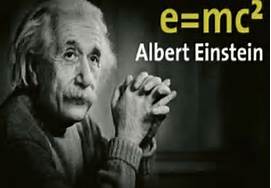
Einstein made E=MC2 look like a simple formula that would enlighten an ignorant, chaotic world to a heightened prospect of infinite possibility. But that simple acronymic equation involves a seemingly endless continuum of sequential deliberation to effectuate a profitable facsimile of Matter’s Origination via Particle molecular Enhancement to fruition of intended Manifestation. – (Spirit’s Version.)
The quantum revolution, akin to Baseball’s “revisionism,” is a very hard process of letting go of old ways of thinking, ways that had framed science since Galileo and Newton and promoted baseball inefficiently via Cobb, McGraw, Landis, and Spalding. These habits were firmly rooted in notions of self-determinism — simply put, scientists, as well as Baseball aficionados, felt that physical causes have predictable effects, or that nature’s simple order followed human intent. The ideal behind this worldview was that nature made sense via obeying rational human rules. Letting go of this way of thinking took tremendous intellectual courage and imagination by scientists like Einstein and others but had not met a substantive criterion of Baseball magistrates (e.g. segregation and “Reserve-Clause.”)
Not until Einstein’s accidental discovery of Quantum Entanglement did the world’s physicists realize that the Universe is not a self-regulated and sustained entity that scientists had assumed from relatively recent discoveries through the “Age of Enlightenment,” but is entirely dependent on an infinitely greater realm beyond it which they now refer to as the Energyverse, and which Spiritually attentive individuals have always surmised as the prospect of HEAVEN.
Determinism, the cornerstone of the classical worldview of mechanics, of planets orbiting stars, of objects falling predictably to the ground, of light waves propagating in space and reflecting from surfaces, had to be abandoned in favor of a probabilistic description of reality. (Thus, the inevitability of Baseball’s Sabermetrics.)
To Einstein, nature had to be rational. But quantum physics showed us that there was not always a way to make it so. Einstein died refusing to believe that “quantum weirdness” was a property of nature. He saw a world that was rational, with things having realities of their own, (but predicated on a Higher Source). Niels Bohr countered that the quantum way was here to stay. Behind their epic dispute was a fundamental question: Could nature’s deepest secrets “be, or not be” knowable to us? They were both correct!
From a “material-basis” it is impossible to form a cogent, unified theory from which to incorporate a singular harmonious effect because it appears to mortal sense that innumerable separate causes are influencing each other in contradictory ways that effect conflicting purposes. – (Middle East Crisis) (There is but ONE Primal-Cause; therefore, there can be No (substantive) Effect from any supposed indifferent cause, and No reality not proceeding from this Great and Only Cause! – M.B. Eddy)
Recently, I felt elated after reading a book by physicist, Joseph Selbie, entitled, The Physics of God. In it he informs that the long-standing view of Materialistic-Science has been virtually superseded by one that incorporates both Scientific and Spiritual discovery to verify what physicists have recently uncovered about the Physical Universe and Its origin as well as the predominant factors regarding its Substance and Maintenance. From what Dr. Selbie and others (including Einstein) had determined, The Universe is not a self-regulated and sustained entity that scientists have assumed for countless millennia but is entirely dependent on an infinitely greater realm beyond it which they now refer to as the Energyverse.
As Dr. Joe has elaborated on the “Intelligent Observer” phenomenon, 20th century physicists established that no particle can be manifested as matter (only as light shines upon it) unless an intelligent observer (Mind) is present. But what was recently established, inadvertently by Einstein’s “Quantum Entanglement,” was that the only communication that is faster than the “speed of light” can occur from within the non-local two-dimensional Energyverse beyond the Physical Universe to a corresponding “Twin” inside. (Heaven’s Superman, in Earth)
“Be still and KNOW I AM, (the quantum portion of WE ARE), is God/Good.” “Be therefore Perfect, even as my Father/Mother in Heaven is Perfect.” “That which is seen is not made of that which does appear.” “The Light of the body is the Eye (Mind). If my mind is single (Focused), my whole body is full of Light. If my eye is scattered my whole body is full of darkness. If the light that is in me be darkness, how great is that darkness?” “Ask and it is given.” “If I ask and receive not, my asking is amiss.” “When I pray, KNOW that I have received, and I do receive!” “As I believe, so is it done unto me.” “That, which is like unto the essence of itself, is drawn.” – That to which I am alike, I am drawn, is drawn to me! Vibrational Reality is Heaven – Without Vibrational Reality, there is no Physical Reality – Seek first what I create in my Vibrational Reality, and I shall have it in my Physical Reality!
Simple statements like those engraved in the above quotations are sentiments easily read and superficially understood by most adherents to Christian, Judaic, and Islamic principles but whose aspirations to emulate seem always to fall short of a complete willingness to demonstrate. Granted, even Quantum Physics, whose initial advocacy of Heisenberg’s “Uncertainty Principle,” would deem it otherwise humanly impossible to emulate Perfection from a materially mortal basis. (It has been intimated on myriad occasions that “only in one’s dreams could the idea of Perfection come to ultimate fruition.”) Put simply, the uncertainty principle states that we cannot pinpoint the position of a quantum object with arbitrary precision. The more we try to ascertain where it is, the more elusive it becomes, as the uncertainty in its velocity increases. (Only evolution of thought will envision Truth. – “I never receive what I want/need, but only what I AM”)
Quantum physics has redefined our understanding of matter. In the 1920s, the wave-particle duality of light was extended to include all material objects, from electrons to me and you (further including the Abraham-Hicks postulate, “there is no thing more spiritual than the manifested version of Spirit.”)
Cutting-edge experiments now explore how biological macromolecules can behave as both particle and wave. But as Abraham-Hicks has redefined Einstein’s Quantum Entanglement, “Ask and Receive” has a new and more valid expectation: Everyone has a “Greater-Self” (Soul/Source) in Heaven’s Energyverse, and communication is instantaneous with the expectation that one’s desired prayer is answered and provided for in Heaven. As Jesus instructed, “KNOW that YOU have received (in Heaven) and You do receive” (in Earth) by Simply Allowing, via Conscious-Thought, for the manifestation of your desire to occur, even incrementally, as you realize I am That I Am.
The development and refinement of all those skills began to take shape as individuals determined to perform at higher and higher standards. And as today, so back then, there were positions (both offensively and defensively) and specific attributes which garnered for individuals more prominence and prestige to whoever demonstrated the highest proficiency.
Throwing and hitting a baseball effectively are very important parts of the game. In fact, Pitchers and Power-Hitters are considered the most prominent characters in the game. The ability to throw and hit a ball hard and far evokes a mythical aggrandizement from which legends are made. What is it that enables one individual to throw or hit harder and farther than another? Are some people blessed with natural ability to perform better than others? What made players like Christy Mathewson, Walter Johnson, and George Herman Ruth so prominent in those early days of our National Pastime?
The game of Baseball is gradually receiving a “facelift” that inevitably will introduce a new paradigm into the minds and hearts of modern baseball enthusiasts. A new story of America’s beloved pastime is at a point of superseding the original model. (It had already surpassed the deviant, and bigoted hypocrisy of deplorable segregationist tendencies with the advent of Jackie Robinson into the flow of an enlightened and progressive advance of Integrity into the Game.) The beauty and grandeur of a glorious past is even now reinventing itself to other nations in a form suitable to days immemorial.
With a plethora of Japanese pitchers coming to America and performing well, one in particular has caught America’s attention with his ability to dominate MLB batters with extraordinary Pitching talent and mechanical technique. But not only does he remind Baseball fans of “the Babe’s” Pitching prowess, Shohei Ohtani also has Ruth’s hitting ability and prodigious power, but runs with the speed of Ichiro. So far, Management has allowed him to help the Team in all 3 Arenas, making him a perennial MVP candidate. He’s already won Three!
The impeccably manicured landscape of the outer-field of play, along with the intoxicating aroma of freshly cut grass, elicited an inspired inhalation which prompted from Plato’s lips an exuberant burst of tri-purposeful poetic praise (encomium) to the majestic Creator of the entire awesome manifested spectacle, the magnanimous composure of all the participants, and the magnificent beauty and elegance of the colossal setting (backdrop) encompassing the divinely choreographed production:
“O thou all-enchanting youthful vigor, how envious am I that thou hast poured into these boys of radiant summer thy spirit of excessive energy and grace. And how the one Creative Form implores your intensity to spark an inferno of teleological support from an adoring vicarious entourage, whose clamoring and intoxicated reverberations fuel the deepest chambers of infinitesimal expanse to implode and expand the centrifugal borders of vast and heroic accomplishment. And from this parallel ground-level view, the mountainous peaks of illuminating speckled waves pour down radiating light to delineate the circulating mists of enthusiastic display, below the multi-layered gradient of uncountable populace — Truly an exhilarating instant to cherish, as with a lifetime of sacred and precious mementos!”
And Socrates, a short smile perforating his stolid cheeks, responds with laconic brevity, “So true!” But, while ambling casually from ‘hinder-land’ toward what is termed ‘infield,’ in baseball vernacular, after watching just a few of the bats-men (as they are referred to), his keen geometrical sense of anatomical symmetry and function and architectural stability and visual acuity could not help but make reference to the varied and inconsistent approaches to what he initially thought was a verifiable ‘techne,’ by which all participants would apply themselves in the same orthodox manner.
“Plato,” he quietly proclaimed, “does there not seem to be a lack of precision that apparently affects the degree of mastery to which these batsmen do aspire? But is it not evident that the thrower-of-the ball (pitcher, by trade) magically affects the speed and nuances of the round projectile with a variety of applications of force, from various segments of body and appendages? And how would these batsmen expect to be consistently successful against such a masterful pitcher and precise manipulator of the baseball as our scholarly ‘Gentleman-Hurler’ affectionately known to Baseball’s early public as ‘Christian-Matty,’ a true Prestidigitator of Mounds-man-ship”?
Plato agrees, and adds, “this game may very well take upon itself an inexactness equivalent to what that foremost twentieth century luminary, Mr. Einstein, has stated in his quantum attachment to relativity, and reluctantly adopted via Mr. Heisenberg’s Principle, ‘at the fundamental levels of matter, causation could very well be a matter of statistical probabilities, not certainties.’ However, from my brief and un-confirmable observational standpoint, I cautiously deduce that stability and an optimal viewpoint could secure better than a marginal advantage with which to offset the varying speeds of the ball and allow for more consistent and direct contact with the batting instrument (formally known as a Bat).”
(Pondering Plato’s words, Socrates pauses reverentially as he silently reminds himself of a brief but concise inference of an eminent 21st century scholar and motivator, Dr. Wayne Dyer, to a scientific statement of our 20th century physicist, Max Planck, as the vanguard to Einstein’s Quantum Revolution, which implies that “to change the way you look at things, changes the things you look at.” – (E.g. High or low batting stance and fielding position. A low stance in batting allows batters to see the ball closer to parallel eye level to differentiate strikes from balls. Outfielders and infielders catch fly-balls, groundballs, and thrown-balls while lining up the ball as close as possible to parallel eye level.)
As the next moment awakens Socrates from this brief reverie, he assents with Plato, but quickly inserts that, “although I feel an innocuous sense of justifiable inquiry, I hesitate to advance a full-scale investigation of the intricacies of our wholesome pastime, for fear of bringing to fruition that which we originally feared might displace our love of the Game. Would it not be wise to observe a while, and further peruse the matter, to estimate more precisely if the foundation and fundamentals of our beloved ‘stepchild’ are in-deed ill-arranged and in dire need of our perceptive diagnostic care and realignment?” “Wise indeed,” asserts Plato. “Let us see what the light of a new day will bring, with its new crop of performers. Is there a generalized ‘techne’ from which every aspirant to highest achievement must conform? Or does each comply with a different art form? Or are those miscreants of proficiency merely not as evolved as the more proficient.
The content of the Macro-World includes everything visible to human and animal perception. The Micro-World is that which is perceivable only via technological enhancement. The Inner-World is that substantive Spiritual Essence that cannot be detected by sense testimony but is the underlying Cause of every Vibrational Effect that precedes all Physical Manifestations.
After purportedly asserting, “I want to think and know, as God,” Einstein presented his Unified Field theory(Dreamer’s imagined ideal) that would allow all that are usually thought of as separate fundamental forces and elementary quantum particles to be written or applied in terms of a single field and ultimate in a “unified well-balanced, manifested experience” by attempting to unify his Theory of General Relativity with Light’s Electromagnetism which in turn would proceed to disentangle any chaotic incorporation of four seemingly distinct forces into One: “strong interaction, weak interaction, electromagnetic interaction, and gravitational interaction,” and eventually provide a practical, balanced application.
A more “spiritualized” slant would not be dissimilar to the relationship of Spirit-Mind, Brain-Body to Soul-inspired thought that “disentangles the interlaced ambiguities of being.” Also, from Mary Baker Eddy’s assignment of meta-physics, “to resolve things back through a reversal of thoughts from which the things were created and exchange the mortal sense of a material object for the Perfect Spiritual IDEAL of vibrational, Immortal Soul.” – (“there is no thing, good or bad, but ‘Thinking’ makes it so!” – Shakespeare. And “there is nothing more spiritual than a manifested version of Spirit.” – Abraham-Hicks. Therefore, the Kingdom of Spirit is within US!
IS THINKING
an interacting network of random thoughts,
The accumulation and utilization of which
Are combined in uninspired pattern and sequence
To form concepts whose ideas make manifested temporal
Unceasing-Prayer, initiated by the curious Observation of a thing Whose origin and Unaccountable presence elicits the Wisdom That Omniscient Understanding disperses
To the ears and eyes of those who seek to Know!
The brain is a conductor for systems of life in all the quanta of animal species in the material world, including Earth and Man. But Mind is the sole director of communication between quanta of the physical material universe and the Spiritual Energyverse of Vibrational Reality in Heaven via Quantum Entanglement of both Soul and Man. – The Material Universe simply began in/from a world of intense darkness, tightly entangled Particles of Blackness waiting unintentionally in each its own crowded isolated solitude of Potential, expecting only nothing while conjuring unexpectantly the possible outcome of any and all potential circumstances. – Good was virtually non-existent in the Relative Unknown Particle Universe but was always and only its ever-present Potential in the vast Oasis of the Energyverse of Heaven!)
The high aspirations upon which individuals are inspired to place their attention correspond to those high vibrations that emanate from the Source of their beings. And the consistency with which their thoughts reinforce these high aspirations corresponds to the frequency by which they constantly attune themselves to their Source. Therefore, a high-frequency vibration is one that is applied by those individuals who aspire to, and ultimately achieve, the highest level of efficiency and proficiency in the endeavor for which they have made preparation for present Personal Perfection. – The Best You Can Be!
(You cannot be “the best you can be” while not eliminating any/all “margins for error”!!!!
Thinking is a process of thought-coalescence establishing what Purely Materialistic-Science would denote as contrary to that of purposeful intent. – Contrary to what the Law of Attraction attests, “That which is like unto itself is drawn.”)
Of the Three Worlds, “Seek First the Kingdom of Spirit (deep Within) and control over the Micro and Macro will be added unto You, Me, and All”!
What better teachers could any student have than Newton, Einstein, Bohr, Planck, Socrates, Plato, and Aristotle to expound the value of abiding under the principles which most assuredly lead to a more reasonable approach to learning anything from Science, Mathematics, Quantum Physics, Rational Thinking, to Hitting and Throwing a baseball? – (As well as ABRAHAM-Hicks to elucidate the fundamental and foundational Law of Attraction!)
Albert Einstein’s name was in the News a lot in the year 2000. He was no longer living but was voted “The Man of the Twentieth Century” by most prominent magazines in our Nation and in the World. The publication of his “Relativity Theories” at the beginning of the 1900s, as well as some of his other prominent works, turned the world upside down with their simplistic but masterful, yet controversial innovations. When his theories were finally proven valid, and applicable to many areas of human endeavor, he (along with Nikola Tesla)was recognized as a genius, and truly the father of twentieth century enlightenment.
Ancient Prototypes
If you have read Plato and are impressed with his Dialectic method of sequential teaching and learning (banter of stimulating questions for thoughtful and immediate reply to incrementally set the stage for advanced understanding), you might aspire to construct a contemporary setting in which the hero of his dialogues, Socrates, would be able to showcase his particularly intriguing talents with an emphasis on “Quantum Reasoning.”
As history has shown, civilization has advanced along uncertain lines since the days of Socrates and Plato. But their wisdom, wherever society managed a foothold in honest and truthful expression, helped nurture countless generations in the march toward attaining the ideal environment in which to ferment a wholesome spiritual, mental, and physical existence.
The Oracle of Delphi may have implied by its presumed deification of Socrates (as well as his literary progenitor, Plato), their lives and works were to be immortalized by the perpetuity of their essence throughout the centuries. Therefore, it would not seem too obscene a gesture for this “dynamic duo,” while transmigrating through Time and Space, to grace some of the noble edifices of our contemporary earthly confines, to observe the progress of man and offer whatever current wisdom emotes from their ever-astute minds.
Their endless journey, to exact from hope the eternal promise of assurance that “Becoming” eventuates into “Truest Being,” finds these exhaustless searchers temporarily perusing such mundane achievements as twentieth and twenty-first century athletic events, with their grand and colossal architectural innovations. Most notable are Professional Baseball games, within the confines of the, at first modest, then gradually, elaborate “Ballpark” and “Domed-Stadium.”
Upon witnessing more than 100 years of development in this current Age’s most civilized society, and delighting in the simple, yet intricate, design of its characteristically National Pastime, the perceptive eyes of our two wandering global advocates for universal expansion via enhanced enlightenment have observed a delineation of human culture and ethnicity, which marks an ethical and moral influence over this nation’s prosperity.
Perched high above the clamor of enthusiastic fanfare, Socrates and Plato, as restrained spectators, quietly engage in their traditional dialogue about the nuances of the sporting activity they have become accustomed to enjoying as a game called Baseball. Their choices of viewing location vary along heavenly porches, upon the rooftop of any stadium that affords prime viewing of the glorious competition below, that triumphantly celebrates the athletic prowess of at least 18 stellar performers and enigmatically exemplifies the nation’s struggle as a free-spirited and ebullient exponent of a workable “democratic” society.
In the relative solitude of their lofty perch, where only the faintness of extraneous sound vaporizes in a skyward trek, their philosophic impressions are innocently conveyed to each other in summations that only acquiesce to the game’s simplistic appeal. Plato sounds out the first volley of reasonable commentary with the words, “Socrates, have we not been witnessing within the framework of organized athletics an activity which truly embodies the essence of divine intervention? Could mere human contrivance order such preciseness, from the trihedral dimensions of the field of play, to the definitive specifications and range of intricate function for the designated participants?”
Socrates affirmatively replies with a nod, but quickly asks, “How can such heavenly synchronization be conjoined to the conscious deployment of human intent? Our rooftop observatory affords us the same sense of purity that we perceive when viewing the planet from the tranquil environment of Space, with no discernable sign of inhospitable conditions (except, perhaps, for the occasional cluster of frantic activists, after a slight miss-conveyance of logistical intent). But has not our own experience shown that beneath our high altitude of celestial serenity, there lurks the inimical earthy agency of subtle subterfuge? What would be our perspective of the game from ‘ground-level’?”
“Do we dare to retreat from our empyreal perch, from which vantage point a clear sense of unadulterated beauty remains uncontaminated?” beckons Plato of Socrates.
Socrates asks in return, “Do we really need to investigate the inner workings of this currently perceived masterpiece, and risk realizing a basis for fraudulent misgivings? If divinity instigates the structural mechanism for all overt action, why need we concern ourselves for the outward manifestation of complete and spontaneous responses to the given stimuli? Certainly, if there are subtleties that differentiate the ultimate quality of play, would not giving a face to a particular entity have a deleterious effect on our objective sense of the game, as well as induce a proclivity for unessential criticism?
Would it be mere feline-curiosity that we fancy, or perhaps an undefined notion that such deliberate restraint would attach the uncharacteristic complacency of an ‘unexamined-life’ as preferable to our own universal proclamation of the benefits that are bequeathed to those who invest in a thorough ‘examination of life’?”
Plato confides, “By not examining the intricacies of the ‘GAME,’ are we not being deprived of knowledge, as intimate as ‘Know Thy Self’? – Of Whom to know is the expanse of TO-BE”!
After rereading and editing my Book numerous times before its publication, and realizing the typical baseball fan’s reluctance to delve deeply into the intricate but redundant themes my ideas transpose onto the pages of every chapter, I have concluded that the best way for such to read this otherwise captivating piece of literature in order to pursue the content and thoroughly absorb its profound context in an energetically mindful manner is to peruse each chapter diligently in one short reading session at a time.
Reading it to any greater extent would run the risk of saturating any phenomenal aspirant to baseball success with mind-cluttering thoughts that he/she never considered would or should be an essential part of the Game of Baseball. Even though Kevon Costner’s “Crash Davis” of Bull Durham fame may not have felt that Quantum Physics could play any role in our National Pastime, times and their enlightenment are evolving.
If a reader whose tendency toward a philosophic appreciation of practical science, even as a dilettante, and has had secret longings to somehow become a professional ball-player (maybe even a “Big-Leaguer”), he/she might become so consumed with hope after reading through the first two or three chapters that a New Prospect might instill an acute interest in continuously reading the entire manuscript to its inspiring conclusion.
The book posits that baseball’s enduring and endearing attributes can be perceived on multiple levels of conscious awareness, transcending the mundane interests of the ordinary sports spectator and encouraging readers to change the way they think about the game, enabling them to observe and understand baseball in a more profound and substantial manner. My Book delves into the multifaceted nature of baseball, exploring the game’s most precious elements of batting and throwing from various perspectives – the physical and mental, the scientific, and the spiritual.
The Title-Page itself as well as the Table of Content should to be pondered before exploring the prospects that are elucidated in the Foreword’s preliminary attempt to verify the relationship between the complexity involved in understanding Quantum Physics in collaboration with the analogous simplicity and viability in perfecting the skills of throwing, fielding, and batting a baseball. (After throwing a perfect strike, why can’t a pitcher consistently repeat the action to achieve the same result? Or any batter hitting a home run and not another?)
One needs only to have watched the L.A. Dodgers during their two-year + span of Championship consistency and observe what players like Freddy Freeman, Mookie Betts, Miquel Rojas, Will Smith, Max Muncy, and others do “religiously” as a pattern of consistent repetition to maintain, reinforce, and expand their preconditioned talent to greater -> Greatest heights of personal and team Glory. – Compared to that of most other Teams that languish in mediocre venues of mortal frustration.
Simplicity is the integration and coordinated alignment of life’s infinite array of Quantum variables within the Unified Field Vibrational-Realm of Infinite understanding. Simplicity is not merely the onset of a primitive evolvement, but rather the culminating effect of organization – not merely the discovery of the “Quantum-wheel,” but its maximum utility by expanded sequential thinking. The more knowledge and better understanding, the Simpler the Organization and Utilization. The (one voice) to the universe sings in simple chords of harmonious function, changing random lifeless particle entanglement with Light’s disentangling order. – Analogous to precise functionality for Fielding, Throwing, and Hitting a Baseball. The only way to describe the best of ballplayers at his/her position, or at bat, is that “he/she makes it look simple.” Although it does appear to be simple, abiding by a strict discipline of simple mechanical redundancy, the best players have “perfected” the techniques for their particular positions through meticulous, repetitive practice, from which the human physical endeavor eventually seems effortless and instinctive. ((E.g. Dodger’s Freddy Freeman’s daily pre-game routine of catching balls thrown in the dirt for him to scoop at First Base which he accomplishes in games to the Penultimate degree. Also, the best of Pitching performance is always preceded by persistent practice to help ensure flawless delivery. – Studying the Bible or any prominent contextual document while confirming to memory for constant recollection demands a higher standard than a “speed-reader’s” quick overview.)
“LET THERE BE LIGHT”!
Science is the amplification of an invisible structure underlying the nature of things while metaphysics resolves things into thoughts and exchanges the mortal sense of material objects for ideals of Immortal Spiritual Soul. – The harmony of which is determined by the endorsement of its principle! – Thus, “there is no thing more spiritual than the manifested version of SPIRIT.” – A-Hicks.
While Astrology, Science and Physics are left to the especially astute minds whose inherent interests in the mundane world of triviality and sport are not quite so acute, there, non-the-less, is an appreciable concern of popular intent for recreation in leisurely fashion as a means of compensating for the stress and struggle of disentangling the corruptible aspects of the macro-world, in which the Universe is prominently displayed. The genius of those entrepreneurs who create such folly for the starving multitudes is sometimes heralded for its imaginative insight or condemned for ultimate depravity. (Baseball, as a Sporting Event, has become a masterful substitute for the archaic interventions of Gladiatorial debauchery that our ancient forefathers thought acceptable to their own warlike reminiscences.)
Quantum Physics, the observation and analysis of the micro-world, and Quantum Mechanics, the established mechanism by which that world is presumed to operate, are the study, application, and utilization of Matter via Ultra – Universal Laws that proceed to a human understanding of the most unseeable fundamental properties contained within the Particle Science of Atomic/Nuclear Energy. – The Hydrogen Atom with its tiny atomic number illustrates the simplicity by which its single circulating electron and singular proton nucleus with its quantumly affixed quarks (3) amass the energy to produce enormous power.
My first Book, The Principle of Baseball… purposefully was to be a working manual to enhance anyone’s understanding of baseball skills and the precise implementation of them through the principles of simple “quantum” mechanics. But the meticulously detailed description of the minutia of persistent facts was felt to go beyond the overt thought-level of the ordinary sports fan, as well as the average ball player. – They’d rather engage speculative sense perception!
It has become apparent to me that most Americans who have become familiar with the great Game of Baseball, with varying degrees of passion throughout the decades, are more enthralled with what appears to the physical senses as random, spontaneous FUN instead of a scientifically artistic practice and quantumly reinforced Talent! Many kids there are who often wish, at least momentarily, that they could eventually have a career as a professional Major League Baseball player. But, as they grow older, out of Little Leagues and other progressive Sandlot organizations, they recognize their skill levels don’t match up to those who have been better schooled with more time and reinforced fundamental inoculation. So, they find other sports that do not have as many perplexing skill standards, or they concentrate on their studies. They will still appreciate the game’s uniqueness and eventually take their own children to professional ballgames and enroll them in Little League, but merely to give them the opportunity to have “baseball fun” and maybe become one whose natural propensity for the game enlists the attention of baseball scouts or Travel Team coaches, in one last hope for improbable immortal-stardom.
But, of all those individuals who continue to play in the higher echelons of Sandlot, High School and College Baseball, very few make it to the Professional ranks and even fewer to the “Big-Leagues.” That’s why it’s a good idea to take advantage of a “paid college education” while continuing promising Baseball Pursuits. Even if you don’t qualify for the Major Leagues, (you probably had the Potential but didn’t have the scientifically sound scrutiny), you now can study for a career in another area of Life, somehow faintly analogous to the substantive value of Baseball – like MLB T.V.’s magnificent Greg Amsinger.
It would be presumptuous to assert that the Simplicity attached to my Perfect Practice of Baseball fundamentals would ensure every student of becoming proficient enough to make it to the Big Leagues. The Simplicity Principle of Baseball is intended to awaken in every advocate of the game an easy and simple means to facilitate proper mechanics necessary to improve his/her play. Things contrived are never really simple; but understanding the intricacies of elements that sustain a natural order makes it possible to simplify/clarify that which often appears complex/difficult.
By reading this book and absorbing its content, any aspirant to baseball success will recognize the difficulty of attaining proficiency but will no longer despair in trial-and-error forays that often depress artistic and energetic initiative. By gaining an understanding of the minute details of the specific movements involved in the specialized aspects of the game, an amateur athlete can gain a greater appreciation for what it takes to possibly emulate and/or supersede the performances of an outstanding player.
The rules are simple and orderly. To abide by them and commit them to proper interpretation are what seem to be difficult, especially to those who prefer to act on their own fallible human mortal senses instead of a sound basic principle. Mary Baker Eddy, a prominent innovative 19th century pragmatist makes this statement for our consideration, “The higher false knowledge builds on the basis of evidence obtained from the physical senses, the more confusion ensues and the more certain is the downfall of its structure.” Therefore, understand SIMPLICITY!
To “believe assuredly” is to have absolute faith in a proven principle. On the human level it’s hard to find an “Absolute” belief in which to have Absolute faith. True consciousness, in all of us, can discern the correct path to take, the right doctrine to espouse, and the most plausibly scientific way to play baseball.
The scientific principle of Baseball is not going to secure a successful application. But a ball player with faith in the “Perfect principle,” and the patience and courage to live by, and practice it unflinchingly, has the best chance to accomplish his/her goal of being a prominently successful “Major-Leaguer.”
When scientific principles are universally understood, every truly “single-minded” Sports enthusiast or Quantum Physicist will be his/her own diagnostician, and the Light of Truth will always be the universal panacea.
Remember, Science is the amplification of that invisible but vibrational structure whose Reality underlies the nature of things to be manifested.
Book Title – Simplicity: The Principle of Perfection – in Science of the Quantum Universe and World of Baseball. I do not want to Self-Publish again. If anyone knows of a Traditional Publishing Agency who would be interested in my Book after reading my Query Letter, please have them contact me for negotiating purposes. APPRECIATED!
Query Letter – Simplicity – Word Count-940
My name is John Paciorek. I am a former Major League Baseball Player who is in sole possession of an historic baseball record which has stood since 1963 and will probably remain throughout Baseball’s immortal future.
I have written five Books, the most recent of which is Simplicity: The Principle of Perfection – in Science of the Quantum Universe and World of Baseball, which is the subject of this Query Letter.
My other books are Plato and Socrates: Baseball’s Wisest Fans (unpublished), “Her-Story” vs. “His-Tory” (unpublished), The Principle of Baseball – And All There is to Know about Hitting (self-published), and, If I Knew Then What I Know Now (self-published).
BASEBALL will always be incomplete or Penultimate at best until its strong playful advocacy begins to understand and apply itself to the ultimate Science of Quantum Physics and be truly established as civilization’s number one Pastime.
My latest endeavor, Simplicity… explores the idea that simplicity is not only a basic starting point, but also the pinnacle of organization and understanding across all aspects of life, ranging from quantum physics to baseball. It emphasizes that true mastery, whether in studying the science of the universe or the mundane world of baseball, comes from understanding and harnessing simplicity through disciplined practice and meticulous repetition.
The comparison of quantum mechanics, where tiny, unseen particles operate in precise, harmonious ways, to the movements and specialized techniques of a baseball player gives an entirely new (almost poetic) perspective to both the game as well as the scientific universe. The idea of “making it look simple” despite intricate layers of precision-practice and fortifying-redundancy gives credence to the redefined adage that “Only Perfect Practice makes Perfect.” – And accentuates the demands of The Law of Attraction which states: “that which is like unto the essence of itself is drawn.” The goal of perfection begins with a simple thought and never ends in its perpetual quest to be all you can be!
I see my book as a deep, multi-faceted exploration into how everything, from atomic structure to human performance, shares a unified field of fundamental truths. It presents a compelling argument that both the universe and baseball are governed by a structured simplicity that, when harnessed, leads toward perfection. If one is drawn to philosophy, science, or sports, this book seems poised to offer rich insights into how these domains overlap.
My book begins by inviting the reader to “think outside the ‘Imperfect Box’” and imagine a better way to incorporate the myriad skills of an elite ballplayer by attaining proficiency without despairing in endless trial-and-error forays that often depress artistic and energetic initiative. With a fascinating blend of classical philosophy and modern sport, I infuse a depth and insight that only the voices and interplay of Plato and Socrates could bring to a discussion about baseball. Their philosophical dialogue elevates the game beyond the physical realm, making it a metaphor for the broader human experience, full of intricacies, decisions, and the unseen forces that shape our actions. This unique approach invites readers to think not only about the mechanics of the sport but about the larger principles at play in both life and learning.
My fusion of quantum physics, metaphysics, and baseball, along with the dialogues between historical figures like Socrates and Plato, creates a truly innovative narrative. I use the perspectives of ancient philosophers to examine both the macro and micro aspects of reality, especially with baseball serving as a fascinating metaphor for precision, unpredictability, and human effort. Their initial philosophical conversation about whether to fully investigate the intricacies of baseball mirrors larger existential questions about life itself. It’s an engaging way to ask, “Is there a universal ‘techne’ or set of principles that govern all endeavors, or is each pursuance governed by its own unique methodology?”
The use of Einstein, Planck, and other key scientific figures alongside the philosophical discourse adds a layer of intellectual richness. Complex topics like Heisenberg’s Uncertainty Principle and Abraham-Hicks’ The Law of Attraction are ways that help bridge the gap between scientific reasoning and more spiritual interpretations of existence. This approach widens a discussion on how thought shapes reality, not only in a cosmic sense but in everyday activities like baseball, which becomes a symbol for focus, intention, and mastery.
References to modern thinkers like Dr. Wayne Dyer, Einstein, Jerry and Esther Hicks and others are particularly interesting, as they show the continuity of ideas from ancient to modern times, all connected through the lens of self-improvement and spiritual inquiry – Evolutionary Progress!
Moving forward, the reader should be eager to see how I expand on these themes in the following chapters, culminating with the final chapter’s “An Imaginative Real-Life Dream.” Throughout the intermittent chapters, the reader might imagine the narrative will continue to weave together various threads of philosophy, science, and perhaps even more of the art and soul of baseball.
The powerful themes of evolution, heritage, and the ever-changing nature of baseball, will provide the reader with interwoven history of the sport’s broader societal shifts, particularly in highlighting figures like Jackie Robinson and Roberto Clemente as pivotal in the game’s development, whether athletically, socially or ethically. Comparison between early legends like Babe Ruth and contemporary icons like Shohei Ohtani and Ichiro Suzuki will fascinate readers, drawing out the continuous evolution of talent and technique over generations while expanding the universal appeal of baseball, especially as a global sport with contributing richness from various cultures.
Mature readers will recognize the “Art” of hitting, throwing and fielding a baseball is more than a physical exercise by a well-conditioned athlete to demonstrate quick reflexes in a random response to the various stimuli presented by a speeding round projectile or perhaps the flying fists or feet of the remarkably focused Bruce Lee and lightning-fast hands of a young Cassius Marcellus Clay. When scientific principles are universally understood, every true sports enthusiast or conscientious student of quantum physics will be his own diagnostician, and Truth will be the universal panacea.
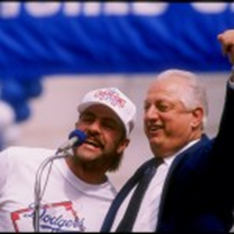
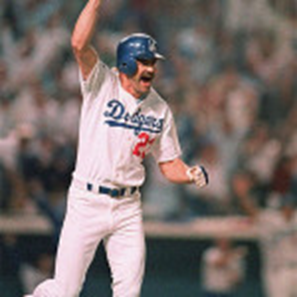
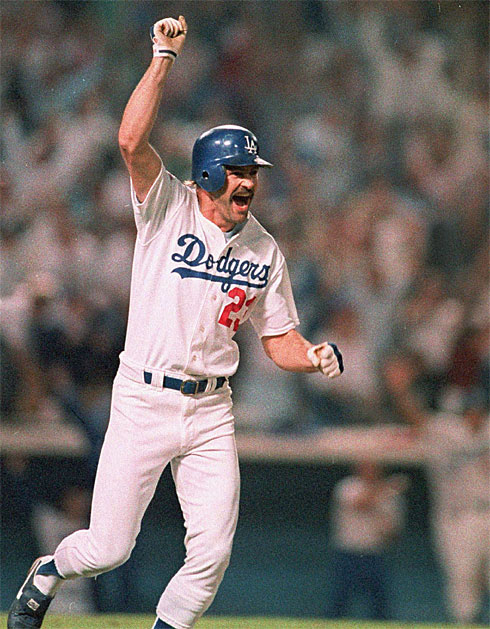
In honor of Kirk Gibson’s Immortal “stroke of genius,” I wish to applaud once again an individual feat in Sports History that I don’t think will ever be duplicated, although some renowned sports writers would evaluate it as merely second or third on the list of memorable home runs ever hit.
As Kirk is currently experiencing some physical difficulties since 2017, I would hope the man who performed the miracle at the 1988 World Series could somehow disentangle himself from the “interlaced ambiguities of his being” and realize that it is natural for him only to feel good, to be well, and to experience perfect bodily conditions.
I am again re-posting (that October 15th, first game of the 1988 World Series) my account of Kirk’s Historic, monumental achievement for your reading pleasure. And perhaps for the inspiration of someone on the 2024 Team to do the Same. ENJOY!
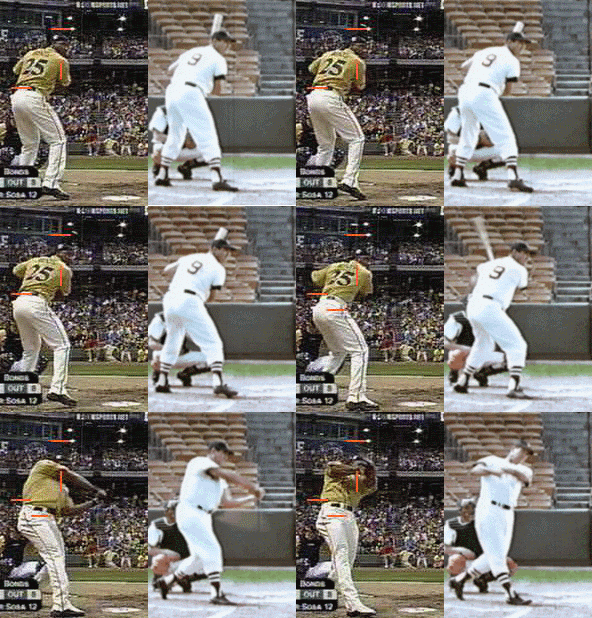
When classifying the “Greatest Homeruns” in Baseball history, the closest that Kirk Gibson’s 1988 World Series “Bomb” ranks to the top of the analysts’ charts, even by MLB Productions, is 2nd or 3rd, behind Bill Mazurowski’s 1960 “Walk-off,” and/or Bobby Thompson’s 1951 “Shot Heard Round the World,” that gave the Giants the pennant. Of course, the main criteria for evaluating these enduring historical footnotes are still the reminiscence of “that” notorious City-Team rivalry and a purely “Under-Dog” sentimentality (Giants’ 15 games deficit before tying the Dodgers, then winning the pennant; and Pirates’ monstrous negative run-differential with the overwhelmingly favorite Yankees). Now, if that criterion cannot be upgraded eventually by Time and Logistics, then a new category must be conceived in order to pay proper respect for what Kirk Gibson did in 1988 when single-handedly, but surreptitiously, leading the Dodgers to the World Series Title. (Space in this category would also have to be reserved for NFL Football’s 1972 “Immaculate- Reception,” which would probably rank 2nd as the “penultimate” contributor to those “Amazing” performances.) In order to hit a single home run, so many aspects of a batter’s swing must be aligned to satisfy the anatomical, physiological, and psychological constituencies composing each player, as afforded haphazardly by the “gods of Baseball.” Most athletes, professional and amateur alike, who have legitimately tasted both the “thrill and agony” of most major sports activities will usually attest to the validity of Ted Williams’ famous yet arguable statement that, “hitting a baseball is the single-most difficult skill to master in all of Sports.” In an essay I wrote entitled, “Einstein and the Home-Run Principle,” Einstein supersedes the Williams’ statement when he parenthetically observes, “Hitting a Homerun is the most difficult thing to do in all of Sports.” To hit a home run, a batter has to be almost perfect in his application of the “the laws of physics” with regard to the mechanics of swinging a baseball bat with precision and power. To be a consistent home-run hitter the batter must also have an understanding of all the elements that are included in the dynamics of hitting a baseball effectively.
Theoretically, it is possible to hit a home run every time a batter swings at a baseball. However, Einstein and others have found through Quantum Mechanics, when trying to establish the essence of matter, that “at the fundamental levels, causation is a matter of statistical probabilities, not certainties.” Therefore, with all the elements and combinations of variables with which a batter has to deal, from within and from without himself, the “uncertainty principle” gives compelling testimony that mastering the “Rubik’s cube” of hitting a homerun every time is highly improbable. However, the knowledge itself, of such feasibility, enhances the statistical probability of success. Not even Albert Einstein and all the renowned physicists of his time, and “saber-metricians” of this modern-era, could have approximated the statistical improbability of what Gibson did on October 15, 1988.
The resounding joy that New Yorkers experienced in 1951 and preserved for decades was not altogether incalculable, since Bobby Thompson had not more than 3 days earlier lit up Ralph Branca with a Home Run that presented as an ominous note a precursor of what was to come. And Bill Mazurowski’s feat that ended the 1960 World Series, although dramatic, cannot have been totally unexpected. Pinch hitter, Hal Smith, had earlier hit a 3-run homer to stake the Pirates to a 2-run lead until the Yankees tied the game in the top of the ninth, thus extending the heart-pounding “see-saw” battle.
“Maz” was 1 for 3 as he led off the bottom of the ninth. Yankee pitcher, Ralph Terry, made the huge mistake of getting the pitch up to the short but powerfully built Pirate second baseman, who took advantage and slugged the ball over the brick wall 408 feet from Home Plate. It was truly a magnificent and endearing moment for the Pittsburgh community and all Baseball fans outside of the Bronx – worthy indeed of memorial status.
All that being said, encomiums to those two distinct episodes in Baseball lore should pale in comparison to the near “mythical” grandeur that highlighted the glorified instant of Gibson’s exalted “blast,” as well as propagated the ecstatic drama that preceded his culminating heroics.
Kirk’s advent into professional baseball is as mysterious as that of the legendary “Roy Hobbs,” without the tragic prelude. Upon completing a successful College football career, it was suggested that he not waste his athletic talent in the “off-season,” and play “a little” baseball for his Spartan baseball team at Michigan State University. In that first and only year of college baseball, he played so well (.390 B.A., 16 HRs. and 52 RBI in 48 games) as to warrant being picked in the first round of the 1978 MLB Draft by the Detroit Tigers. He was with the Tigers for 9 years and was a key figure in attaining a World Series title in 1984.
After being determined as one of the ballplayers being “black-balled” by MLB Franchises in the notorious “Collusion Scandal” of 1987, he left the A.L. Tigers and in January joined the Hapless Dodgers of the National League, whose dismal ‘87 season needed something of a “Hobbsian” spark to generate new life into a ball-club in disarray. At Spring Training a few opportunities presented themselves early in Camp to set the stage for an immediate change of direction in Team attitude and focus. This would eventually lead the march to a much-improved status and uncontested standing in the National League West to win the Division by 7 games. Frivolity and practical jokes took a back seat to Kirk’s ultra-professional and business-like mentality, and the team flourished from beginning ‘till the season ended. His season ending stats earned him National League MVP honors while helping the Dodgers win 21 more games than the season before.
But it was his uncommon “personal leadership” and otherwise intangible, undaunted presence that invoked the “mythical hero” image his teammates and adversaries had learned to admire and would attempt to emulate. In the NLCS, although injured, Kirk still performed heroically in clutch situations, and his timely home runs in the 4th and 5th games clinched the National League Pennant and advanced the Dodgers into an improbable World Series entitlement. Kirk purportedly had done all he could to get the Dodgers to that World Series, but “they” were presumably going to have to get to the “Promised Land” without him, for the injuries he incurred along the way were too severe for any “mortal” to overcome and give a last-ditch effort. All the world would have accredited the Dodgers with a valiant effort for just making it to the “Final” Series. Everyone knew that even with Gibson, there was slim if any chance for them to beat the powerful Oakland Athletics, whose superior arsenal of player personnel had amassed an incredible record of 104 wins to 58 losses. And even with Kirk’s Premier status with the “baseball gods,” the “Arrogant- As” knew that “one player does not a team make.” With Gibson being an “absolute” scratch from the line-up (he wasn’t even at the pre-game introductions ceremony), the first game of the Series began unexpectedly with a first inning 2-run homer by Dodger, Mickey Hatcher. The “As” came back with 4 runs in the top of the 2nd and held a 2-run lead until the Dodgers scored again in the 6th. The game remained at 4 to 3, Oakland leading in the bottom of the 9th. Throughout the game, there were brief TV glimpses of Kirk Gibson hobbling around in the dug-out as he was traversing the distance from the training room and back, trying to massage and loosen his painful joints and hamstrings. Ever-optimistic, Tommy Lasorda seemed to be coaxing his beleaguered star, to see if any type of “miracle” was in the offing.
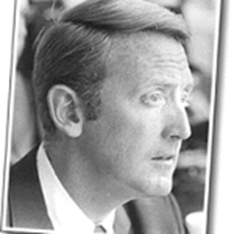
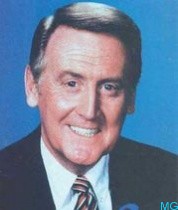
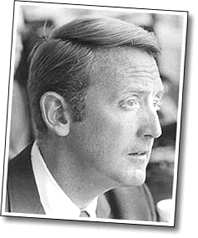
Vince Scully repeatedly commented that there was “absolutely” no chance of Gibson making an official appearance. With T.V. and radio broadcasts coming into the locker room, Gibson heard one of Scully’s commentaries as if providence were beckoning for him to consider an alternative thought. In sudden contemplation of all that was transpiring before him, Kirk realized an inexplicable surge of unwarranted confidence streaming through his consciousness. As in a biblical reference to Jacob wrestling with the “man” inside, Kirk’s vision of Princely accommodation could not be suppressed.
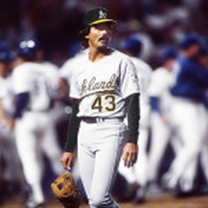
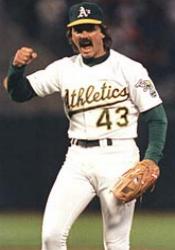
The decision was made; his mind was determined; “the die was cast”; but only the portentous action itself was forestalled. “Will I look like and be a fool? What in hell could I possibly do? I can’t even walk! What or Who do I think I am?” would have been the common queries instigated by mortal fear that must be wrested away from that mind intent on fulfilling a noble purpose. After Dodger pitching blanked the Athletics in the top of the ninth, the otherwise stalwart performance of Oakland Pitcher, Dave Steward, ended when statistically prudent “As” manager, Tony LaRussa replaced his Starter with the League’s Premier “closer,” Dennis Eckersley.
It looked like a sure win for Oakland, since “Eck” was destined to face the bottom of the Dodger line-up (though somewhat of an ominous sign, in hindsight). Eckersley got the first two outs in rapid succession, and was about to face a formidable, former teammate who was set to pinch-hit for the 8th batter in the line-up. Meanwhile, in the Dodger dug-out, Lasorda learned that Gibson had begun a personalized mental and physical rehabilitation process, which immediately spurred Tommy’s ever-percolating mind to envision a preemptive scenario of his own. After appointing Mike Davis to pinch hit for Alfredo Griffin, he surreptitiously placed Dave Anderson in the on-deck circle, to make Eckersley and LaRussa think that they could afford to be a little cautious with Davis (a potential threat) and contemplate the “end” by pitching to the very weak-hitting Anderson. All potentially constructive Dodger strategy lay in the proposition that Gibson regain a semblance of his former self. Yet, even if he could overcome the acute pain and obvious debility, what could he hope to achieve in this debilitative condition? Bob Costas would later remark that while he was in the stairwell of the Dodger dug-out, he could hear the groaning, anguishing strokes of a batter desperately trying to ready himself for one last at-bat, even “one last-swing,” while teammate Orel Hershiser was feeding baseballs onto the tee for Gibson’s convenience.
Although most of his teammates must have sensed the futility of Kirk’s somewhat contrived heroism, they probably also could not have expected anything less from “the man” who had proven himself so many times before. They all must have thought the “good prospect” all but possible. However, their past experience would at least warrant a “statistically” derived-at chance of success. “YOU’VE GOT TO BELIEVE” would have been the genuine inspirational sentiment pouring into the ears of the players from the mouth and heart of Tommy Lasorda and the Great Dodger in the Sky.
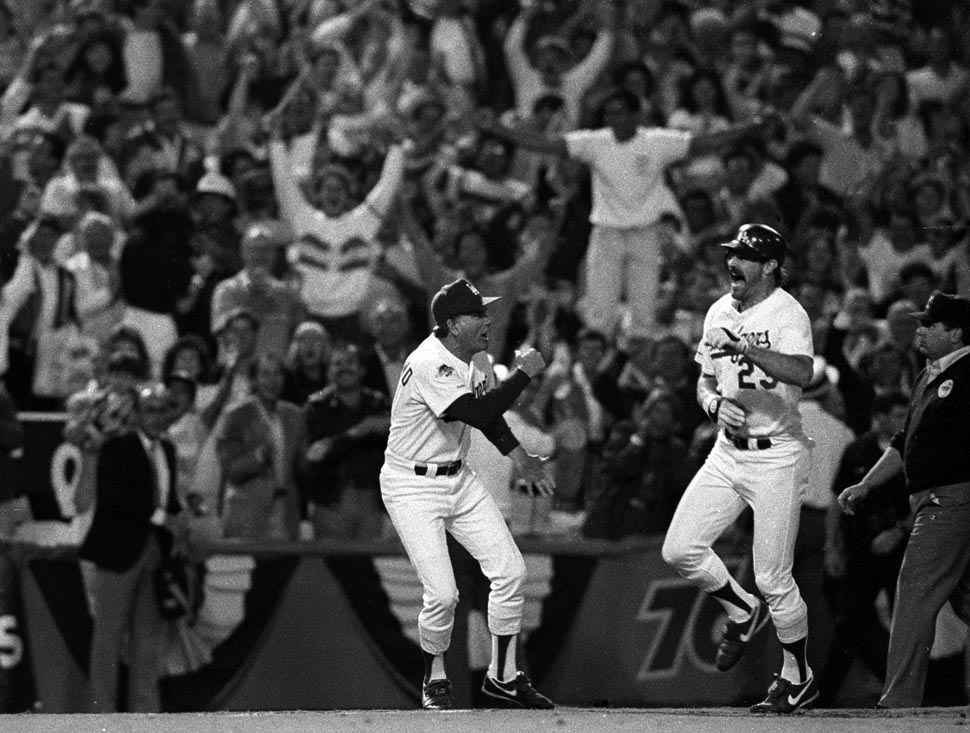
Kirk is now sitting at the end of the dugout bench, fully dressed, and armed with helmet and “hickory,” speculating the purview the situation has presented. “I have inspiration and commitment to do something, but what, and how far can my own determination carry me? Will Davis get on base to set up my ‘grand entrance,’ and what emotion will the fans exude? And will it give me that final burst of adrenaline to be propelled to heights previously unknown?” Gibson was afforded no additional time to mentally peruse the circumstances of the present situation, for Eckersley just walked Mike Davis. Taking a deep yet unstrained breath, Kirk’s electrifying and confident image popped onto the top step, then out of the dugout to the thunderous roar of the now ecstatic and frenzied crowd. “That’s what I wanted to hear,” thought Gibson, as he must have restrained the urge to shed at least a tributary tear of ineffable joy he and his patrons could feel in this present moment of triumphal hope. Lasorda’s unending chants of “new promise” inspired his Team and the Dodger Faithful to loftier heights of exaltation, as Kirk finished his preliminary swings. His slow, deliberate, but majestic walk to the plate must have been a nerve-wrenching ordeal for the Oakland pitcher, even though he exuded a confidence rather than impatience to get the game over. One could only speculate as to what order of thoughts must have been aligning themselves in Gibson’s mind as his footsteps proceeded into that rarefied cubicle of variable distinction. Before assuming his characteristically “Spartan” batting-stance, his back cleat scratched the hardened dirt for a foothold to secure a base from which his afflicted body might launch its purposeful attack.
He was finally ready, and none too soon for the exasperated Eckersley, who let his arm commence with the business at hand, firing a blazing, side-arm, tailing fastball, for which Gibson must have felt a tad unprepared. All observers couldn’t help but notice the constrained, oblique wrenching, late response Gibson’s off-balanced body and bat conveyed as it almost completely missed the ball. The second pitch gave the same explicit message, and the fans as well as Eckersley himself must have sensed that “the Gibber” was no match for the “Eck.” Kirk was behind 0 and 2 in what seemed like a “heartbeat,” and Dennis was determined to finish him off on the next pitch. Eckersley’s disdain for Gibson’s futile attempts was obvious as he was about to throw another fast ball, same speed, to the same spot (away). The fact that Kirk looked bad, but progressively better on each swing did not escape Eckersley discerning eye. Gibson knew that his body needed only a short quick turn, but even that was too slow to get his arms activated.
On that third fast-ball, Kirk was prepared to shorten the turn and throw his arms and hands more quickly. The result was a swing with little power, as his arms and hands were too far out in front, and his wrists rolled over way too soon. He was grateful that he even made contact for an otherwise worthless dribbler that forced him to run toward first before the ball fortuitously struck the edge of the infield grass and abruptly darted foul, thus extending his at-bat. (That had to hurt!)
After his first pitch to Gibson, it became obvious to Eckersley, as well as the “brain-trusts” in both dugouts, that Kirk was not the optimum threat for which everyone fancifully hoped or cautiously suspected. But he was quickly portending to be a formidable adversary, even in his seemingly “powerless” condition. “Eck” recognized that with all the pitches Gibson was subtly calculating, making superficial contact with everyone, it might only be a matter of time before he can put one in play, perhaps to the detriment of Oakland.
Therefore, he can’t let Davis steal second base. Before his second and third pitches he made 3 throws to keep Davis close. With 2 strikes on Gibson, the Dodgers might be desperate. His 4th pitch was a ball outside, going a little farther to see if Kirk would bite beyond the fringe. He didn’t. Since “Eck” didn’t throw over before the 4th pitch, Davis attempted a steal on the 5th. Gibson had his best swing yet but fouled it back. Eckersley didn’t think Davis would steal on consecutive pitches, and he was correct, but threw “Ball 2” in the process. Before his 7th pitch, he threw to first base again. But on the pitch to Gibson, the ball was further outside, and Davis successfully stole second base, much to the consternation of LaRussa, Eckersley, and the “As” dugout as the count rose to 3 and 2.
The situation had not developed the way Eckersley intended. Gibson’s impotent yet “frisky” at-bat posed a conundrum whose immediate solution never materialized. So there was only one direction in which to go!
As Dennis Eckersley was truly an adroit “student of the game,” he, like the many who had come before him, usually observed Warren Spawn’s masterful advice when administering to their trade: “It is the batter’s duty to have good timing and rhythm to perform effectively, while it is the pitcher’s duty to off-set that rhythm and timing with variable speeds and placement of pitches.” As for Gibson the batter, he had neither rhythm nor timing when he first came to the plate. But through the course of his gauntlet-like “trial-by-pitch” he had developed both to a rather insignificant level. Now, it was thought by “Eck,” to end this dilemma. He knew what he had to do. He’d done it before, with great success. And he will do it, NOW!
The Game wasn’t necessarily on the line, if his strategy failed. Gibson would walk, and the Dodgers would still have a runner in scoring position, presenting merely a secondary condition that would quickly be dismissed. But “Eck” was confident, he could not fail. “This is absolutely the ‘last hand’.”
All the “Cards” being dealt, Eckersley landed (in Poker parlance) a 4th Ace, while Kirk had a pair of Jacks and the 7, 8, 9 of Clubs. Kirk could have kept the pair and thrown the other 3 away, but instead threw the Jack of Hearts, keeping its “Brother-in-Clubs.” The statistical probability for Eckersley’s success was astronomical! Kirk Gibson seemed to have been abandoned by the “gods” and his mythological legend was about to become irreparable. The most he could hope for was simply a mimesis of that “Luis Gonzalez” swing and flare a base hit that might tie the game. But in Eckersley’s mind, a game-ending out is all Gibson’s “gunna” get!
There’s the tying run on second base. Eckersley is in his “stretch.” The count is 3 and 2. “Eck” is about to deliver the most potent pitch in his repertoire. The Dodger dugout is ecstatic. Now, with the fleet-footed Davis in scoring position, a base-hit would tie the game, and that is all and the best they could expect from their forlorn hero. But Eckersley had other plans! And what was Gibson himself thinking?
Just before Eckersley was to deliver his “secret” pitch, Kirk abruptly stepped out of the batter’s box, as if to regain his composure under this momentous circumstance. But, in that instant, a higher source seemed to beckon him to recall an otherwise innocuous fact that Kirk had read in a report prepared by an astute and meticulous “scout” (Mel Didier) before the playoffs began. After pondering the present situation, all statistical possibilities seemed to be aligned in a favorable position. And the curtain was about to fall with a dramatic conclusion on one of these conquering heroes, each with his own weapon of invincibility in hand (Reminiscent of the final poker-hand in the movie, “The Cincinnati Kid”). But which will project the image of “The Man”?
Kirk looked toward the mound, then stepped into the “Box,” knowing he had all the information he needed (his final card was dealt). But is his faith in his belief strong enough; and will his mind’s commitment to act unflinchingly, in spite of his apparent bodily condition, enable his warrior-heart? 55,000 spectators are about to find out as well. Neither antagonist is smiling but each exudes an indefinable confidence, even while knowing well that “one will die today.”
Eckersley takes his stretch and prepares his “Load” for delivery. Gibson makes a final but ominous mental query designating his unquestioning tact as “the die is cast” once more, “Sure as I’m standing here, partner, you’re going to throw me that ‘back-door’ slider, aren’t you?”
As the pitch leaves his hand, Eckersley recognizes the ball’s trajectory to be perfect, right where he wanted it. With all the pitches he had thrown, he knew Gibson would see the ball moving directly toward the outside. He also thought Gibson’s quick sense would assume that, since his side-armed fast ball “tails,” the pitch’s destination would obviously move farther outside for a ball. He was expecting Kirk to momentarily relax, and not have enough time to respond to the pitch’s abrupt deviation of speed and direction, until it was too late – The “Aces” were “face-up”!
“Sure enough,” realized Kirk, upon first glance! His “absolute faith,” and patience allowed him to wait. He’d not yet lifted his front foot as he did previously while expecting Eckersley’s fast ball. An extra nanosecond of Time was in his favor. “Now, all I have to do is get my timing right, to be able to explode at the precise moment!” In his extremely “closed stance,” as he discerned the ball’s outside trajectory, he waited until he could detect its subtle and abrupt turn toward him. Then his front foot exaggerated its deliberate stride toward third base, as his body was “gathering” its forces to uncoil as his foot would plant into the ground.
Eckersley couldn’t help but notice that Gibson’s physical demeanor was uncommonly composed as he unobtrusively glided in the direction from which the ball was finally descending (as if he knew what was coming). “Eck” saw Kirk’s foot plant, his body uncoil, his arms extend, and in a final explosive lunge of shoulders, hands, and wrists, observed the bat contact the ball with an uncanny perfect synergy that launched the round projectile with improbable force in the direction from which it came.
With all spectators and both dugouts watching in apparent disbelief, the ball kept rising and carrying farther and farther in its ellipticity until it finally disappeared over the right-field wall, as Kirk’s final card resoundingly struck the table as a 10 of Clubs – and a “Straight Flush.”
Throughout the day not a hint of joy was expressive of the face of Kirk Gibson, only a stoic-facade hiding pain, disappointment, resentment, and disdain for his helpless and impotent condition. As the abrupt follow-through of his celestial swing of bat was completed, and he cautiously embarked on an unrehearsed, and as yet undefined, trek, an observer could detect a gradual change in facial disposition. The remorseful look of indifference was suddenly transformed into a heavily distinguishable canvas of ecstatic jubilation.
And in a moment of triumphant glory, he pumped his bent right arm in successive punches along the side of his beleaguered body after the subjugated leather-bound projectile did indeed traverse the height of the outfield fence for an uncontested, historic “masterstroke” (Tour De Force) of amazing ramifications, the conclusion of which would be directly revealed.
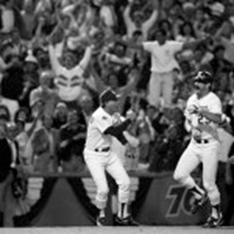
The instant of evidentiary proof of Gibson’s success immediately transformed the hopeful yet solemnly cautious dispositions of Dodger fans and Teammates (who hadn’t really believed in “Santa Clause”) into genuinely faith-filled followers who, at that “holy instant,” probably could have moved a mountain or two.
The dug-out Dodgers were streaming out onto the field, arms flaying and voices shouting “Hallelujah” (from the roof-tops) to their “resurrected “messiah” as he buoyantly circumnavigated the bases in all but reconstructed, glorified form.
His amazing feat did provide a Home Run of incomparable distinction. And it did win that First Game of the “Series,” in abrupt and miraculous fashion. But the intangible essence of that single act of unfathomable “Heroism” also unlocked a momentarily imprisoned spirit of Team unity that suddenly “empowered” the Dodgers to claim the 1988 World Series Title, even without Kirk playing another moment of any of the remaining 4 games. Kirk Gibson’s Home Run was truly the “single-most amazing performance piece in Sports history.”
Postscript: As unlikely as Kirk Gibson’s conquest was, at that momentous October event, what more climactic expression of exaltation could be spontaneously delivered than that spoken by Baseball’s “immortal bard,” Vin Scully,
when he exclaimed, as Kirk was rounding the bases, “In a year that has been so ‘improbable,’ the ‘Impossible’ has occurred.” Truer words were never spoken. No one in the world could have expected Gibson’s humble yet triumphal salute, “I came; I saw; I conquered!” And for the last 36 years, legions of followers have echoed the words of another prominent and renowned sportscaster (Joe Buck) as he commented repeatedly, in breathless exuberance, “I DON’T BELIEVE WHAT I JUST SAW! I DON’T BELIEVE… WHAT I JUST SAW”! Nothing in Sports History can equate to Kirk Gibson’s “improbable” and “impossible” act of courage and accomplishment. The only historical event that would have shared in equipollence would have been “The Battle of Thermopylae,” if this Spartan warrior had been there to defeat the Persians.
Post – Postscript:
2024 World Series – Freddie Freeman:
As a suggested prospect for Historical recognition, at the beginning of this Post, I proposed a Gibsonian Corollary to that 1988 Masterpiece, “And perhaps for the inspiration to someone on the 2024 Team to do the Same.” I am overjoyed by the TEAM response during the first three games of this year’s World Series, with Hopes that the fourth, fifth, (sixth or seventh) games will prove as successful as its providential past. The Yankees won game 4, and would their new momentum subvert Destiny’s call for a De Ja Vu Experience?
Particularly impressive and somewhat reminiscent of singular glorification is the prophetic expression of grandeur by one Freddie Freeman who in some familiar fashion shared a similar Heroic Effort of his Prototypical Predecessor. During a week of convalescence for a severely sprained ankle between Championship Series, it was questionable whether Freddie would participate in the World Series. But because of his solid determination, dedication, and discipline, he worked his way back to a playable physical condition.
And, as Destiny would be assured by the “Great Dodger in the Sky,” with two outs in the bottom of the last Inning, with the Bases Loaded and the Yankees ahead 3 to 2, the previously physically afflicted Dodger First Baseman hit the pitcher’s first pitch into the Right Field Pavilion (near where Kirk hit his) for a History-Making, never before “Walk-Off” Grand-Slam home run and another “Game ONE World Series victory” for the “Indomitable Los Angeles Dodgers.”
As with the inevitable despair felt by Dennis Eckersley, Tony LaRussa, and the Oakland Athletics in 1988, the Yankees were experiencing the same in 2024 as Freddie had also hit home runs in the Second, Third and Fourth Games while the Dodger pitching successfully stymied its Rivals (except in Game 4). The Dodgers eventually won Game 5 in equally dramatic form as 1988, while Walker Bueler captured the spirit of Orel Hershiser in finishing the Dodger Pitching Duties by mowing down the Yankee offense in the bottom of the Ninth to secure a 7 to 6 Dodger World Series Victory and Championship.
The likely MVP Candidate was realized in the person of Freddie Freeman whose 12 RBI performance through all five games tied the MLB World Series record – in silent commemoration of the fact that Kirk didn’t receive that Award because he was physically unable to play again after that First Game. Even though Orel certainly deserved the Award, he acknowledged the spirit of Gibson energized his own heroic effort. And how many of the 2024 Dodgers were unofficially cognizant and imbued with that Indomitable Spirit of the 1988 Dodger Team?